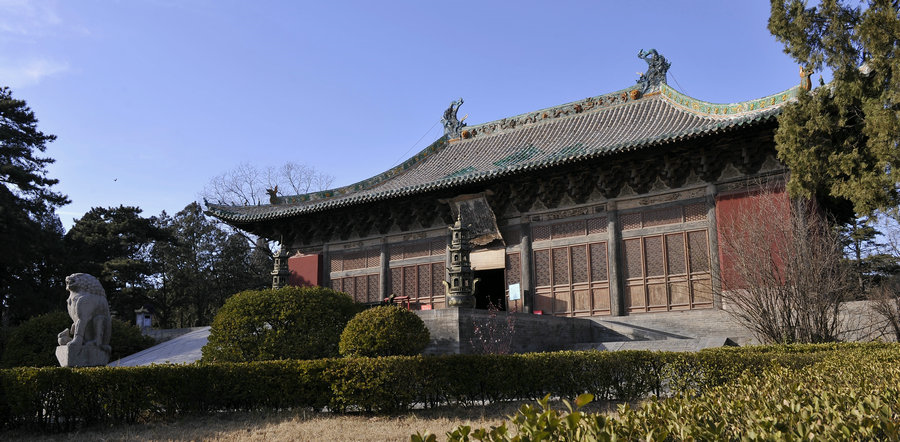
Yongle Palace
Introduction
Yongle Palace (palace of eternal joy), is one of the three largest Taoist temples in China and the biggest surviving Taoist temple from the Yuan Dynasty (1271-1368). It spans an impressive 248,000 square meters. Renowned worldwide for its architectural artistry and murals, it is located about 3 kilometers north of Ruicheng county's center in Shanxi province. Endowed with magnificent and fascinating scenery, the Palace is bounded by the mountains in the north and the Yellow River in the south. It is 60 kilometers away from the Temple of Universal Salvation (Pu Jiu Si), the Stork Tower and the Ferry of Iron Cow in Yongji city, 30 kilometers away from the Guangyu Temple in Yuncheng city, 66 kilometers away from Huashan Mountain and 200 kilometers away from Luoyang city.
Yongle Palace started to be built in 1247 and was completed in 1358. The whole project took 111 years. On March 4, 1961, it was chosen into the first batch of key historical sites under state protection by the State Council. In 2001, the State Post Bureau issued the stamps of its murals. In 2004, it was rated as a National AAAA-Level Tourist Attraction by the National Tourism Administration. In 2011, it was awarded “one of the top ten most beautiful cultural relics in Shanxi province”.
Historical Context
The Palace was originally built in Yongle town, 20 kilometers southwest of Ruicheng county. Yongle town is the birthplace of Lyu Dongbin, one of the ancestors of Taoism. In the late 1950s when the Sanmenxia Reservoir was being constructed, the Palace was expected to be in the submerged area according to the planning. With the approval and instruction of Premier Zhou, the Ministry of Water Resources allocated 2.2 million RMB for the relocation project of the Palace. From 1959 to 1965, the whole palace with its cultural relics was moved to the Ancient Wei State Site of the Western Zhou Dynasty, 2 kilometers north of the county center. The six-year relocation project and the relocation of Egypt’s Abu Simbel temples were known as “the two miracles of artificial relocation in the world history of cultural relics”
Architectural and Artistic Features
Yongle Palace preserves four exquisite wooden structures of the Yuan Dynasty, which are located on the central axis of 500 meters long. The east-west axis extends through the Temple of Lyu Dongbin, Temple of Wealth, Temple of Emperor Xuantian to the Tomb of Lyu Dongbin. These structures, solemn and serene, are of great importance in the history of Chinese architecture. The most impressive is the 1000-square-meter mural of the Yuan Dynasty, distributed in the Longhu Hall, Sanqing Hall, Chunyang Hall and Chongyang Hall. There are many works of different styles such as figures and landscape paintings in gongbi style. Known as the “Oriental Art Gallery”, the mural is one of the existing treasures of ancient mural art, a masterpiece in the history of world art, and a valuable legacy of world culture. Since its opening in 1979, it has become an imitation practice base for major art schools in China.








